
Best VPN for Privacy in 2026: The Most Secure VPN Services for Online Privacy
Introduction
Online privacy has become an increasing concern for internet users around the world.
Internet service providers, advertisers, and even governments can potentially monitor browsing activity and collect data about online behavior.
Because of this, many people turn to Virtual Private Networks (VPNs) as a way to protect their personal information and maintain greater control over their digital privacy.
A reliable VPN encrypts your internet traffic, hides your IP address, and prevents third parties from tracking your online activity.
However, not all VPN services offer the same level of privacy protection.
In this guide, we analyzed some of the most popular VPN providers to identify the best VPNs for privacy in 2026, focusing on security architecture, no-logs policies, and independent security audits.
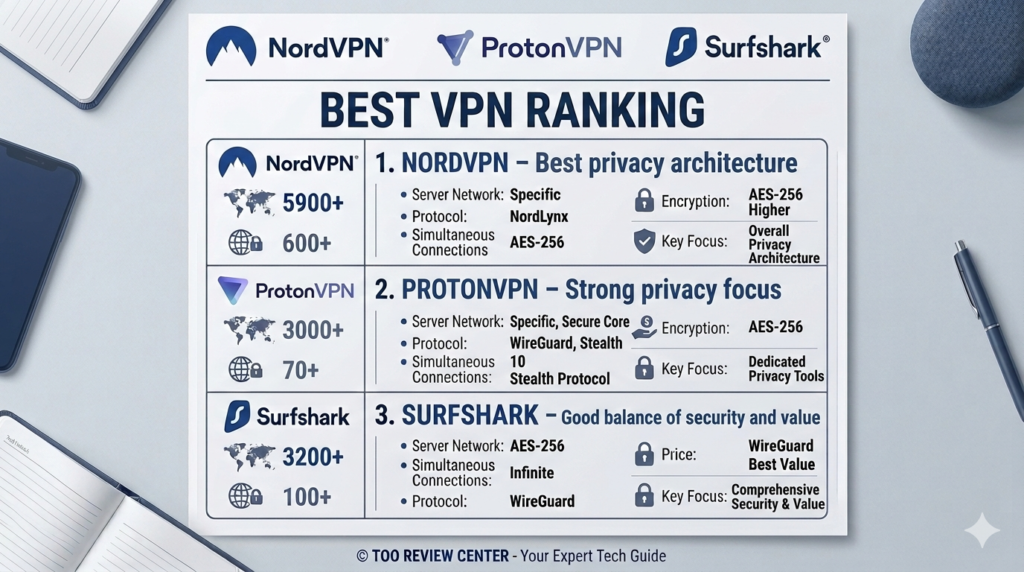
Quick List: Best VPNs for Privacy
| VPN | Best For | Key Privacy Feature |
|---|---|---|
| NordVPN | Best overall privacy VPN | Independently audited no-logs policy |
| ExpressVPN | Strongest infrastructure security | TrustedServer RAM-only servers |
| Surfshark | Best value privacy VPN | CleanWeb privacy protection |
1. NordVPN — Best Overall VPN for Privacy
NordVPN is widely regarded as one of the most privacy-focused VPN providers available today.
The service uses strong AES-256 encryption, advanced security protocols, and a strict no-logs policy that has been independently audited.
NordVPN also operates a network of RAM-only servers, ensuring that no user data remains stored after a server restart.
Key privacy features include:
• independently audited no-logs policy
• RAM-only server infrastructure
• strong AES-256 encryption
• DNS leak protection and kill switch
Because of its combination of strong encryption, audited privacy policies, and advanced infrastructure, NordVPN consistently ranks among the best VPN services for privacy.
2. ExpressVPN — Best for Infrastructure Security
ExpressVPN is known for its strong focus on security architecture and infrastructure design.
One of its most notable technologies is TrustedServer, which operates entirely on RAM-only servers.
This means that all data is automatically erased whenever the server is rebooted.
ExpressVPN also uses strong encryption standards and regularly undergoes independent security audits.
Key privacy benefits include:
• RAM-only TrustedServer technology
• audited no-logs policy
• strong encryption protocols
• high transparency standards
These features make ExpressVPN a trusted choice for users who prioritize privacy and security.
3. Surfshark — Best Affordable VPN for Privacy
Surfshark offers strong privacy protection at a competitive price.
The service uses modern encryption protocols and operates a strict no-logs policy.
Surfshark also includes several privacy-focused tools designed to enhance online anonymity.
Privacy features include:
• strong encryption protocols
• no-logs policy
• CleanWeb tracker blocking
• unlimited device connections
Because of its balance between privacy features and affordability, Surfshark is a popular option for users seeking privacy protection on a budget.
Why Privacy Matters When Choosing a VPN
Not all VPN services provide the same level of privacy protection.
Some providers may collect connection data or operate in jurisdictions with weak privacy regulations.
When choosing a VPN for privacy, it is important to consider factors such as:
• encryption standards
• logging policies
• server infrastructure
• independent security audits
Understanding these factors can help users select VPN providers that truly prioritize privacy.
What Is a No-Logs Policy?
A no-logs policy means that a VPN provider does not store information about user activity.
This typically includes:
• browsing history
• IP addresses
• connection timestamps
• traffic data
Some VPN providers have their no-logs policies verified through independent security audits, which helps increase transparency and trust.
Additional Privacy Features to Look For
Some VPN providers offer additional features designed to strengthen privacy protection.
RAM-Only Servers
Servers that run entirely on RAM ensure that data cannot be stored long term.
Multi-Hop Connections
Some VPNs allow users to route their traffic through multiple VPN servers for additional anonymity.
Tracker and Ad Blocking
Some VPN apps include tools that block trackers and malicious advertising networks.
Final Verdict
Choosing the best VPN for privacy requires evaluating several important factors, including encryption standards, privacy policies, and infrastructure security.
While many VPN services claim to prioritize privacy, only a few providers combine strong encryption, audited no-logs policies, and secure server infrastructure.
Services such as NordVPN, ExpressVPN, and Surfshark offer strong privacy protection and are widely recognized as some of the most reliable VPN providers available today.