

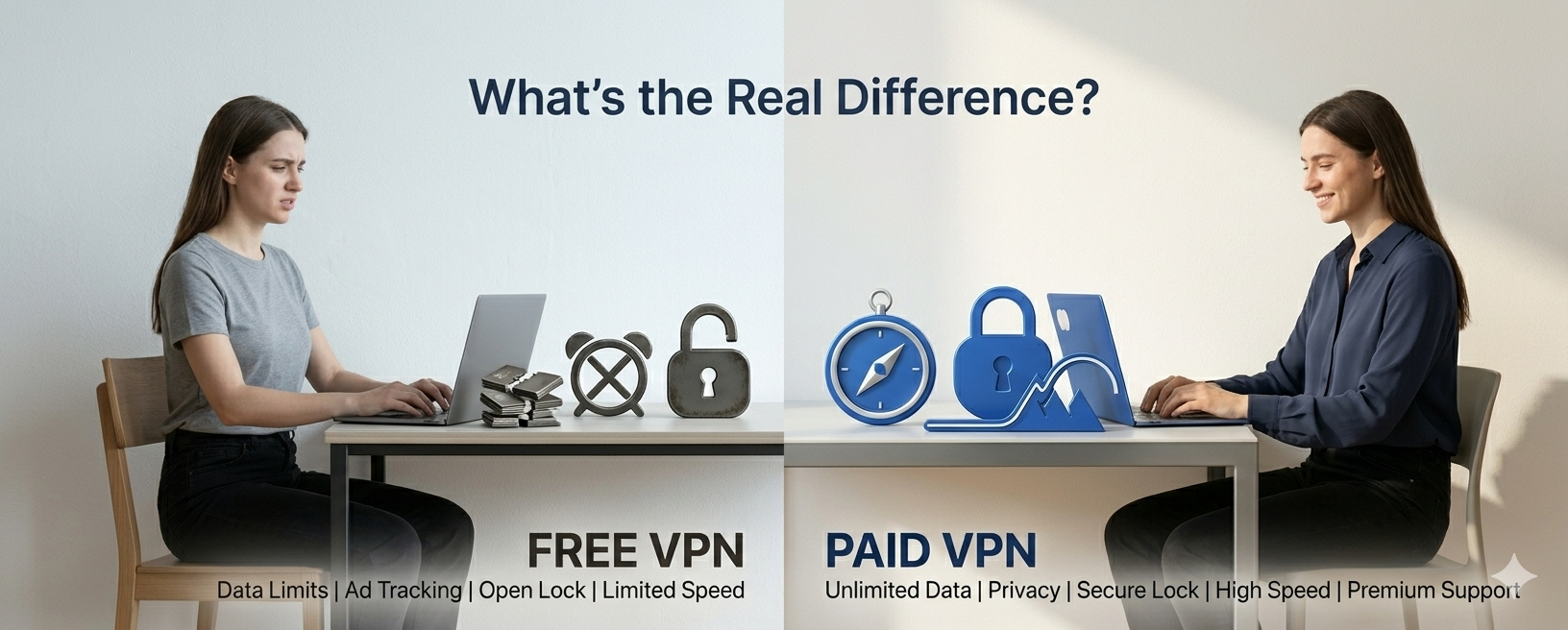
You search for a VPN and immediately see dozens of free options promising privacy, security, and unlimited access — all at no cost. It sounds like an easy choice.
But then you start wondering: if it’s free, how does it actually work? And more importantly — what’s the catch?
Many users assume all VPNs offer the same protection. But in reality, the difference between free and paid VPNs can be significant — especially when it comes to privacy, speed, and reliability.
👉 In other words, your internet may not be as private — or as free — as it seems.
Choosing the wrong type of VPN could mean slower speeds, limited access, or even compromised data.
Let’s break down the real difference so you can make the right decision.
Now consider how often your online activity is tracked. Websites, advertisers, and even your internet provider can monitor what you do online — building a detailed profile of your behavior without you even realizing it.
At the same time, many users face frustrating restrictions when trying to access content. Streaming services, websites, and apps often limit what you can see based on your location, creating a fragmented internet experience.
👉 In other words, your internet may not be as private — or as free — as it seems.
This is exactly where a VPN becomes relevant.
But what is a VPN, and how does it actually work in real life — not just in technical terms?
Let’s break it down in a simple, practical way.
A comparison between free and paid VPN services
Not all VPNs protect your privacy equallyPNs protect your privacy equally
Anyone choosing a VPN for security, streaming, or browsing
Helps you avoid unsafe or unreliable VPNs
If you’re considering using a VPN, the next step is understanding which providers actually deliver real performance.
Compare the fastest VPNs for streaming and security on our Best VPNs and VPN Comparisons pages.
You connect to a VPN server.
Your data is encrypted to protect it from third parties.
Your traffic is routed through another location.
Your IP is hidden and your activity becomes more private.
👉The difference is not how they work — but how well they perform.
A VPN encrypts your internet connection, hides your IP address, and protects your online activity from tracking and potential threats.
A VPN is safe when provided by a trusted company with strong encryption and a strict no-logs policy. Some free VPNs may not meet these standards.
With increasing online tracking and security risks, using a VPN is beneficial for most users in 2026.
| VPN | Best For | Rating | Label |
|---|---|---|---|
| NordVPN | Overall performance | 9.7 | ⭐ Best Overall |
| ExpressVPN | Speed & streaming | 9.5 | 🔥 Most Popular |
| Surfshark | Budget users | 9.3 | 💰 Best Value |
See full breakdown in Best VPNs 2026.
Beginners
Streaming
Privacy Lovers
30-Day Money-Back Guarantee